
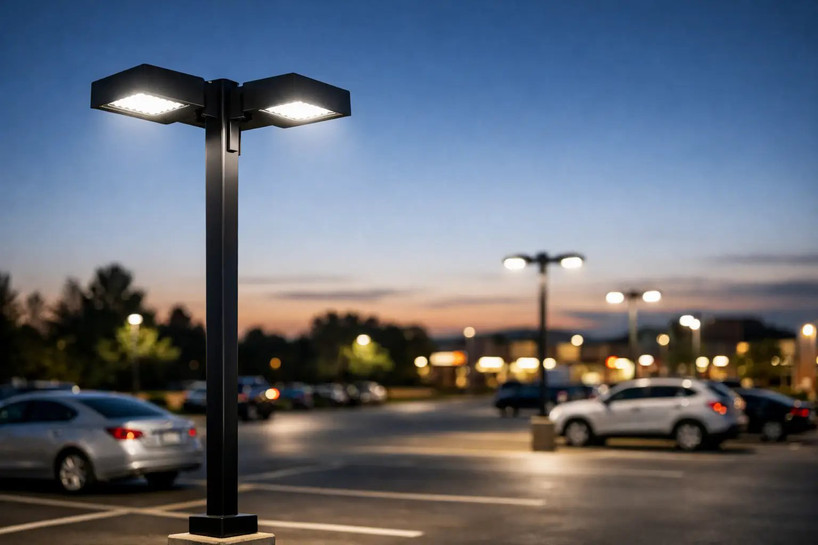
A parking lot that looks adequately lit from the property line can still have dark walkways, harsh glare at entrances, and weak visibility between vehicles. Parking lot lights need to do more than produce high lumen numbers. They need to provide usable lighting for driving lanes, parking spaces, pedestrian routes, loading areas, and building approaches without wasting energy or disturbing neighboring properties.
For contractors, facility managers, and commercial property owners, the right specification begins with the site plan - not the fixture price alone. A lower-cost fixture that creates uneven coverage, requires premature replacement, or fails local requirements is not a budget win. The goal is dependable illumination, controlled operating cost, and a fixture package that fits the pole, voltage, controls, and site conditions already in place.
Start With the Area That Needs Light
Parking areas rarely have one uniform lighting requirement. Open parking fields, perimeter spaces, drive aisles, accessible parking, sidewalks, pickup lanes, dumpster enclosures, and entrances all call for different light levels and distribution patterns. Treating every pole as identical often creates either overlighting or the shadows that lead to complaints.
Begin by separating the property into zones. Main vehicle areas need consistent visibility for drivers and pedestrians. Building entrances and crosswalks typically need higher vertical illumination so faces, changes in elevation, signage, and door hardware are easier to see. Perimeter areas may need controlled lighting that supports security without throwing light beyond the property line.
A photometric layout is the practical way to verify coverage before ordering. It shows maintained foot-candle levels across the site and identifies dark spots, hot spots, and spill light. For a straightforward retrofit using the same poles and mounting heights, an experienced lighting supplier or contractor can often use the existing layout, fixture spacing, and pole height to recommend an appropriate LED replacement. New construction, expanded lots, unusual geometry, or sensitive neighboring uses deserve a project-specific plan.
Choose Parking Lot Lights by Distribution, Not Wattage
Wattage matters for energy use and circuit loading, but it does not tell you where the light goes. Two LED area lights with similar wattage and lumen output can perform very differently because their optics distribute light differently.
A Type III distribution is commonly used along roadways, drive lanes, and lot edges where the fixture must push light forward and outward from one side of a pole. Type IV is often selected for perimeter locations because it provides a stronger forward throw with limited light behind the pole. Type V is a symmetrical pattern suited to poles located within a parking field, where coverage is needed in all directions. Some sites use Type II optics for narrower paths or lanes.
Mounting location controls the choice. A fixture on the edge of a lot should not use the same distribution as a fixture in the center. If a pole sits near a property line, backlight control becomes especially important. Look for fixtures with appropriate BUG ratings - backlight, uplight, and glare - when local ordinances, dark-sky requirements, or adjacent residences are factors.
The trade-off is straightforward: broad distributions can reduce fixture count in open areas, but only when pole spacing and mounting height support that pattern. Forcing a wide optic into a tightly spaced layout can create glare and excessive overlap. A photometric plan resolves these questions before material reaches the jobsite.
Match Lumen Output to Pole Height and Spacing
LED retrofits are often discussed as wattage replacements, such as replacing a 400W metal halide fixture with a 150W LED area light. That comparison is useful as a starting point, but it should not be the final specification. Metal-halide halide output declines significantly over time, whereas quality LED fixtures deliver more consistent performance. The existing wattage may also have been wrong for the site from the beginning.
Pole height, fixture spacing, and required light level should drive output. A lower-mounted fixture may need a more controlled distribution to avoid glare and maintain uniformity. Taller poles can cover more area but may require higher output and optics designed to carry light to the intended distance. Very tall poles in large retail, industrial, municipal, or stadium-adjacent lots may require high-output area or sports lighting rather than standard parking lot fixtures.
Selectable-wattage LED area lights are useful when site conditions are known, but final output needs flexibility. They can simplify stocking and allow field adjustment within the manufacturer-approved settings. They are not a substitute for a lighting design, however. Set the wattage too low and coverage suffers; set it too high, and the site may produce glare, higher energy costs, and code issues.
Select Color Temperature for Visibility and Site Expectations
Most commercial parking lot applications use either 4000K or 5000K LED lighting. A 4000K fixture produces a neutral white appearance that many offices, multifamily properties, retail centers, and mixed-use sites prefer. It provides clear visibility without the cooler visual character of higher color temperatures.
A 5000K fixture delivers a crisper, cooler white light and is common at industrial facilities, warehouses, distribution centers, and larger commercial lots where high perceived brightness is a priority. Neither option is automatically better. Match the CCT to the property type, municipal requirements, existing exterior lighting, and expectations of tenants or customers.
Some communities restrict higher color temperatures or require warm-color lighting near residential areas, environmentally sensitive locations, or wildlife corridors. Check the local code before standardizing a project around 5000K. If the application requires a specific color temperature, choose a fixture with a fixed, documented CCT or confirm that the selectable CCT setting meets the specification.
Controls Can Cut Operating Cost Without Sacrificing Safety
Parking lot lighting should not run at full output when the property is closed or lightly occupied unless the security plan requires it. Photocells, timers, and networked controls can align operation with actual daylight and business hours. For many retrofit projects, a fixture-mounted photocell is the simplest option for dusk-to-dawn operation.
Motion sensors and occupancy-based dimming can reduce energy use in low-traffic areas, but they need careful setup. Sudden changes in light level can be distracting in active drive lanes, and a sensor with limited detection range may not respond early enough for approaching pedestrians or vehicles. Bi-level dimming often works better than full shutoff, maintaining a lower security light level until activity triggers higher output.
For larger portfolios, centralized controls can support scheduling, monitoring, and maintenance alerts across multiple properties. The additional cost makes the most sense when a facility has enough fixtures, operating hours, or energy-management requirements to justify it. A simple photocell may be the right answer for a small standalone lot.
Verify Mounting, Voltage, and Site Conditions Before Ordering
A fixture that performs well on paper still has to fit the existing pole and electrical system. Confirm the mounting method early. Common options include slip-fitter mounting for round tenons, direct arm mounting, square pole mounting, and trunnion mounting. Pole material, shaft shape, drilling pattern, and tenon diameter all matter.
Verify the input voltage as well. Many commercial LED area lights operate across 120-277V, while larger facilities may require 347-480V fixtures. Do not assume the replacement matches the existing circuit. Check the branch voltage at the pole, especially on older properties where previous modifications may not be documented.
Also account for environmental exposure. Parking lot fixtures should be rated for outdoor use and have appropriate ingress protection for rain, dust, and wind-driven debris. In coastal areas, corrosive environments, or facilities with demanding maintenance expectations, housing finish, gasket quality, surge protection, and warranty terms deserve closer review. A replaceable photocell, driver access, or serviceable components can reduce downtime later.
Plan the Retrofit as a Complete System
The fixture is only one part of the job. Review poles, brackets, wiring, photocells, fuses, handhole covers, and grounding while planning the upgrade. Aging poles or damaged mounting hardware can turn a simple LED replacement into a safety issue. If poles are being added or relocated, confirm foundation requirements, wind-load ratings, and local permitting before fixtures are selected.
It is also smart to standardize where practical. Using a limited number of fixture families, CCTs, drivers, and control methods makes future maintenance easier. That does not mean every location needs the same product. It means the selected products should be intentional, documented, and available when a replacement is needed.
Last Stop Lighting can help commercial buyers compare LED area lights, poles, mounting options, controls, and project quantities when the specification is still taking shape. Bring the pole height, spacing, voltage, mounting style, and target application to the purchasing conversation. Those details lead to a better fixture decision than wattage alone.
The best parking lot lighting projects are the ones nobody has to think about after dark: drivers can navigate confidently, pedestrians can see their path, neighboring properties are not hit with glare, and the maintenance team is not chasing failures. Specify for the actual site, then buy fixtures built to keep working there.