
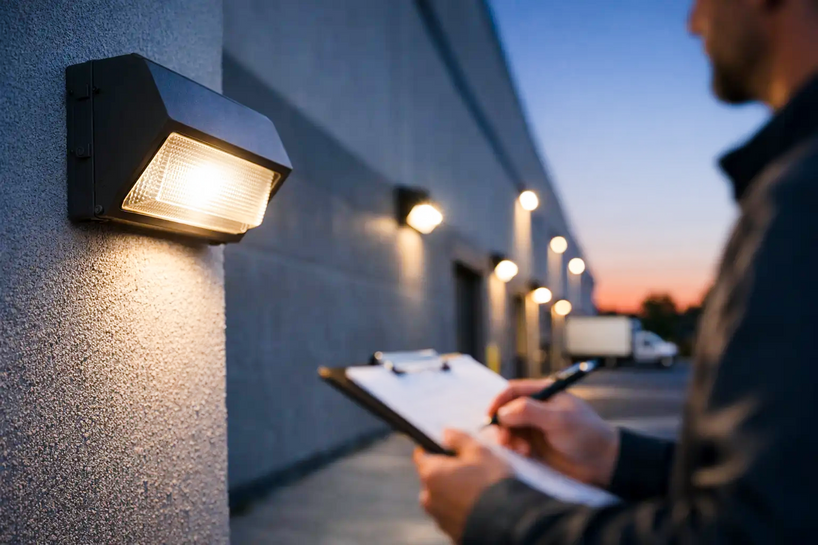
A wall pack can look like a simple replacement item until it creates glare across a neighboring property, leaves a loading zone underlit, or fails after one winter of exposure. Commercial wall packs need to do more than put light on a wall. They must direct useful light where people, vehicles, doors, and cameras need it while standing up to the voltage, weather, and operating schedule of the site.
For contractors, facility teams, and property owners, the right specification starts with the application rather than the old fixture's wattage. An LED wall pack may use far less power than the metal halide or high-pressure sodium unit it replaces, but equivalent wattage alone does not establish light distribution, mounting suitability, or code compliance.
Start With the Area Below the Fixture
Wall packs are perimeter fixtures. Their job is usually to illuminate the ground plane along a building, access route, service door, or drive lane. Before selecting lumens, identify what the fixture is expected to light and how far that light needs to reach.
A rear employee entrance, for example, may need controlled illumination around a door, keypad, steps, and nearby walkway. A warehouse loading dock needs broader coverage for truck movement, dock doors, and staging activity. A wall pack mounted along a retail facade may need to provide consistent light between fixtures without sending excessive brightness toward customer-facing areas or adjacent residences.
Mounting height changes the answer. A fixture installed 10 feet above a personnel door does not need the same output or distribution as one mounted 20 feet above a service drive. Higher mounting positions generally require more output and a wider usable distribution, but increasing wattage is not always the best fix. Fixture spacing, mounting location, optic design, and obstructions all affect the resulting foot-candles.
For larger sites, a lighting layout is worth the time. It can expose dark gaps between fixtures, overly bright wall surfaces, and spill light beyond the property line before equipment is ordered or installed.
Commercial Wall Packs: Choose the Right Fixture Style
Traditional full-cutoff wall packs remain a practical choice for many commercial exteriors. Their forward-throw distribution pushes light outward and downward while reducing uplight. They work well on warehouse walls, utility buildings, loading areas, and service-side perimeters where functional coverage is the priority.
Slim LED wall packs are often used when a lower-profile appearance matters. They can be a good fit for office buildings, retail centers, multifamily properties, and renovated facades. Do not assume a slim housing means lower performance. Compare the published lumens, distribution, and mounting height recommendations rather than judging output by fixture size.
Adjustable wall packs add flexibility when fixture aiming needs to be refined in the field. Some models allow the head to tilt, making them useful for uneven terrain, sloped access routes, or projects where the fixture must be positioned above a canopy edge or architectural obstruction. The trade-off is that aiming must be completed carefully. A poorly aimed adjustable fixture can create direct glare and put light where it has little value.
For entry doors and compact building-side areas, a smaller LED wall pack or downlight-style fixture may be more appropriate than a high-output perimeter unit. Oversizing these locations wastes energy and can make a doorway uncomfortable for employees, visitors, or security cameras.
Compare Lumens, Not Just Replacement Watts
Commercial lighting buyers often inherit a specification that calls for a 100-watt or 250-watt replacement. That reference can help identify the old technology, but it should not be the final purchasing criterion. LED wall packs are better evaluated by delivered light, wattage, distribution, and control options.
A low-wattage LED unit can be suitable for a doorway or short walkway. Mid-output fixtures are common for building perimeters, while higher-output models may be needed for truck courts, wider drive lanes, and tall mounting heights. The actual lumen package should reflect the site requirements, not simply the highest output available in the product category.
Selectable-wattage wall packs are especially useful for standardizing inventory across multiple locations. A contractor can install the same fixture family and set the wattage for each mounting height or coverage zone. This reduces SKU complexity, but it does not replace planning. Setting every fixture at maximum output may increase glare, energy use, and maintenance costs without improving site safety.
Color temperature deserves the same attention. A 4000K fixture is a common commercial choice because it provides clear neutral-white visibility without the cooler appearance of many 5000K products. A 5000K wall pack can be effective for active service areas, industrial perimeters, and sites where visual contrast is a priority. On hospitality, multifamily, or neighborhood-facing facades, 3000K or 4000K may be a better visual fit. Local ordinances and project standards can also limit color temperature, especially in areas with dark-sky or wildlife requirements.
Verify Electrical and Environmental Requirements
A wall pack is exposed equipment. The housing, lens, gasket, driver, photocell, and mounting hardware all need to match the conditions at the installation point. Look for a wet-location rating and an IP rating appropriate for the expected rain, dust, and washdown exposure. In coastal environments or areas exposed to road salt, corrosion resistance is a major factor rather than a product detail to overlook.
Voltage must be confirmed before ordering. Many commercial LED wall packs operate on 120-277V, covering common branch circuits in offices, retail buildings, and light industrial sites. Facilities with 347-480V service need fixtures specifically rated for that voltage range. A voltage mismatch can stop an installation immediately or damage equipment.
Also, review ambient temperature ratings. High heat near rooftops, mechanical yards, and sun-facing masonry can shorten driver life if the fixture is not rated for those conditions. In cold climates, verify that the fixture and any battery backup or sensor components are approved for low-temperature operation.
If the location contains flammable vapors, combustible dust, or other classified hazards, a standard wall pack is not an acceptable substitute for a listed hazardous-location fixture. That decision should follow the site's area classification and applicable electrical code.
Controls Can Cut Energy Without Reducing Security
Exterior lights do not always need to run at full output from dusk to dawn. Photocells are a straightforward option for switching wall packs on at night and off at daylight. For many sites, that is enough.
Motion or occupancy sensors can lower energy use in low-traffic areas by dimming fixtures until activity is detected. These are useful at side doors, equipment yards, dumpster enclosures, and selected service areas. They are less suitable where constant light levels are needed for surveillance, active loading operations, or safety procedures.
Dusk-to-dawn operation, motion response, dimming level, and hold time should be considered together. A sensor that returns to a very low level too quickly can make a parking or service area feel inconsistent. A carefully selected control strategy preserves baseline visibility while avoiding full-output operation when the area is empty.
Confirm Installation Details Before the Order Is Released
The fixture data sheet should be reviewed alongside the field conditions. Check the mounting surface, junction box arrangement, conduit entry, fixture dimensions, and whether the selected model includes the required photocell or sensor. A replacement project can be delayed by a mounting pattern mismatch even when the lighting specification is otherwise correct.
Use this final pre-purchase check for every wall pack order:
- Confirm mounting height, spacing, and the coverage area required below each fixture.
- Match voltage, wet-location rating, and ambient temperature limits to the site.
- Select output, CCT, and optics based on the application rather than the old fixture wattage.
- Verify controls, photocells, sensor settings, and any code-driven requirements.
- Check mounting hardware, conduit access, lead times, and project quantity pricing.
For multi-building upgrades, choosing a consistent fixture platform can simplify maintenance and replacement stocking. It also gives facility teams a uniform appearance and familiar control setup across the property. Last Stop Lighting can help commercial buyers compare fixture specifications, project quantities, and specialized options before a purchase is finalized.
The best wall pack is not necessarily the brightest one on the wall. It is the fixture that produces usable, controlled light for the actual task, fits the electrical and environmental conditions, and gives the facility a dependable exterior lighting system for years of nightly operation.