
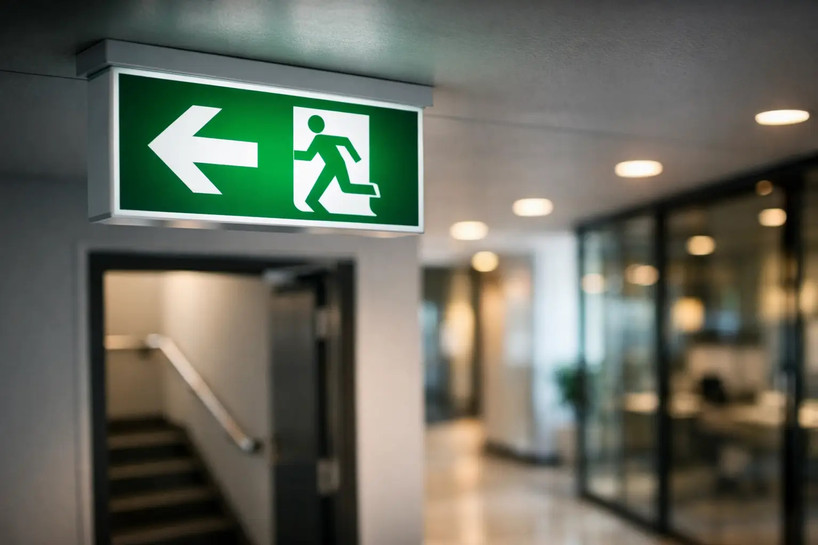
A failed emergency exit sign is not a minor maintenance issue. During a power outage, fire alarm event, or smoke condition, occupants need a clearly marked path out of the building without hesitation. For contractors, property managers, and facility teams, selecting the right sign means balancing code requirements, electrical conditions, visibility, mounting constraints, and long-term service needs.
The lowest-priced unit is not always the right replacement. A sign that does not match the building’s voltage, directional layout, local approval requirements, or environmental exposure can cause delays during inspection and additional labor during installation. Start with the application, then match the fixture specifications to the project.
Choosing Emergency Exit Signs by Application
Most commercial exit signs are internally illuminated LED units. LEDs have largely replaced incandescent and fluorescent models because they use less energy, run cooler, and typically provide a longer service life. For a facility with dozens or hundreds of signs operating continuously, that lower wattage can reduce maintenance calls and operating costs over time.
The basic choice is between an AC-only exit sign and an emergency battery backup exit sign. An AC-only model illuminates while normal building power is available. A battery backup model includes an internal rechargeable battery that keeps the sign illuminated when normal power fails. In many commercial applications, exit signage serving a required means of egress must remain illuminated during a loss of normal power, but the applicable requirement depends on the adopted code, occupancy, and authority having jurisdiction.
Before ordering, confirm whether the project calls for a standard LED exit sign, a self-powered emergency exit sign, or a combination exit sign and emergency light unit. Combination units can save wall or ceiling space by placing two adjustable emergency heads on the same housing. They are useful over doors, in corridors, and in small commercial spaces, but they are not a substitute for a proper emergency-lighting layout. The light heads still need to provide usable illumination along the egress path.
Match the sign face to the exit path.
Exit signs are available in single-face and double-face configurations. A single-face sign is generally used where occupants approach from one direction. A double-face sign is appropriate where the sign must be visible from two directions, such as an intersection, open corridor, or center-mounted ceiling location.
Directional indicators matter just as much. Select a sign with the correct chevron or directional arrow configuration for the path of travel. Many commercial models include field-selectable or removable directional chevrons, which can simplify stocking and installation. Even then, installers should confirm the final direction after the sign is mounted and the exit route is established.
Red and green legends are both common in the United States. The right choice may depend on existing facility standards, local rules, tenant requirements, or the approved plans. For replacement work, consistency across a floor or building often improves wayfinding and avoids a patchwork appearance. For new construction, confirm the required legend color before purchasing project quantities.
Electrical and Backup Specifications That Matter
Voltage is one of the first details to verify. Commercial emergency exit signs are commonly offered in 120/277V models, allowing them to operate on either standard 120V branch circuits or 277V commercial lighting circuits. Some specialty products use a different voltage range, so never assume a replacement is universal simply because the housing looks similar.
Battery backup runtime is another key specification. Many self-contained emergency products are designed to provide at least 90 minutes of operation after normal power loss, a common benchmark in life-safety applications. Actual performance depends on the unit design, battery condition, ambient temperature, age, and maintenance history. If the project requires extended runtime, remote capacity, or generator compatibility, review the product documentation and electrical plans rather than relying on a standard unit.
Self-diagnostic emergency exit signs are often a strong fit for larger facilities, hard-to-access locations, and sites with recurring inspection requirements. These units perform scheduled testing and indicate battery or lamp-system faults through status lights. They do not eliminate the need for facility testing and recordkeeping, but they can make routine maintenance more efficient by identifying a failed unit before an inspection or emergency exposes the problem.
For remote emergency heads, confirm whether the exit sign or combo unit is rated to power external fixtures. Remote-capable models have defined output limits. Adding heads beyond the listed capacity can reduce required emergency duration or create a noncompliant installation.
Mounting, Environment, and Visibility
A sign can have the correct electrical rating and still be wrong for the location. Surface wall mounting, ceiling mounting, end mounting, recessed mounting, and edge-lit configurations each serve different architectural and egress conditions. Universal-mount signs can reduce ordering complexity, but make sure the included canopy, hardware, and face configuration actually support the intended installation.
Recessed and edge-lit exit signs are often selected for offices, hotels, lobbies, healthcare spaces, and other finished interiors where appearance matters. Thermoplastic signs are a practical, economical choice for many back-of-house and general commercial applications. Die-cast aluminum housings provide a more durable option for locations exposed to heavier traffic or where a premium architectural finish is specified.
Environmental ratings deserve close attention. A dry-location sign should not be installed in an exterior breezeway, parking-garage ramp, washdown area, or damp loading zone just because it is under a roof. For exposed or moisture-prone spaces, specify a damp-location or wet-location unit as required. Cold-weather performance also matters in unconditioned spaces, since battery output can decline at low temperatures.
Visibility is not just about the word EXIT. Mounting height, obstructions, door swing, corridor turns, smoke conditions, and ambient lighting all affect whether occupants can identify the route quickly. Walk the egress path during design or replacement planning. A sign hidden above a soffit, behind a decorative element, or around a corner does not serve the building well even if it powers on.
Code Approvals and Local Requirements
Commercial life-safety lighting is governed by adopted building and fire codes, electrical requirements, product listing standards, and local enforcement. National references may include the International Building Code, International Fire Code, NFPA 101, and NEC requirements, but the enforceable rules are the versions adopted by the local jurisdiction and interpreted by the authority having jurisdiction.
For that reason, approval labels should be treated as procurement requirements, not marketing details. Look for appropriately listed emergency and exit equipment, including UL 924 where required. Projects in jurisdictions with specialized requirements may need Chicago-approved or New York-approved exit signs. These products are not interchangeable with every standard commercial sign, so confirm the project location and plan notes before ordering.
Historic buildings, healthcare facilities, schools, multifamily properties, industrial plants, and public assembly spaces can also have occupancy-specific considerations. When plans, specifications, or an inspector call for a particular product construction, legend color, emergency duration, or testing feature, purchase to that requirement rather than substituting based on appearance alone.
A Practical Replacement Checklist
For a straightforward replacement, verify the existing sign’s voltage, face count, directional indicators, mounting method, housing dimensions, and whether it has battery backup. Then check the installation environment and local approval needs. Taking a few photos of the installed unit, junction box, mounting canopy, and surrounding egress route can prevent ordering the wrong configuration.
For renovation and new-construction work, review the full emergency egress plan instead of replacing signs one at a time. This helps identify missing directional signs, inconsistent legend colors, insufficient emergency-light coverage, and units that are difficult to service. It also allows buyers to standardize on compatible products, batteries, and test features across the facility.
Last Stop Lighting supports commercial buyers with standard LED exit signs, emergency battery backup models, combo units, and specialized approval-oriented products for regulated applications. For larger projects, confirming the specification before release can protect the schedule, budget, and inspection outcome.
The best exit sign purchase is the one that fits the drawing, the circuit, the mounting location, and the code path before the installer arrives. Verify those details early, keep replacement information on file, and treat every illuminated exit as equipment that may be needed at the exact moment normal operations stop.