
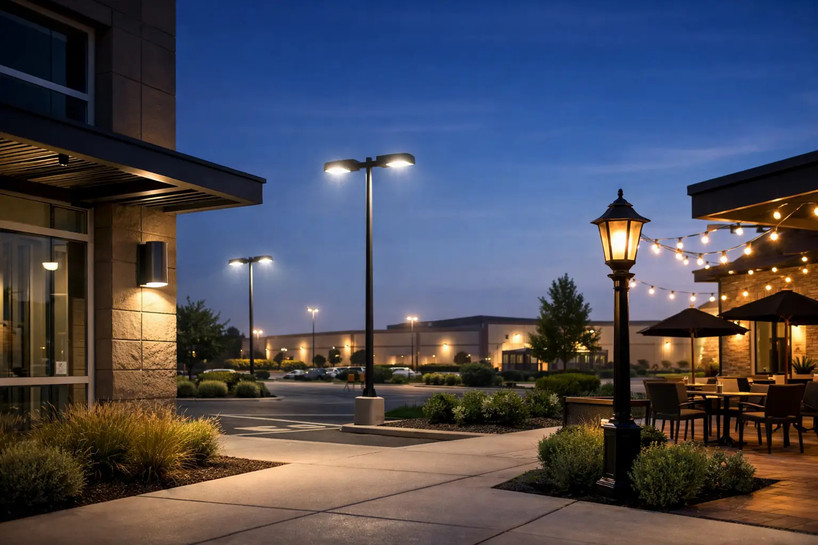
A parking lot can look adequately lit from the street and still leave dark gaps between vehicles, glare at building entrances, or weak visibility at loading zones. Commercial outdoor lighting has to do more than put light outside. It must support safe movement, reliable operations, site security, and energy control while fitting the electrical system, mounting conditions, and project budget.
The right fixture begins with the application, not a wattage number copied from an old spec. A 150W LED area light may be appropriate for one parking field and excessive for another. Pole height, spacing, beam distribution, surface reflectance, nearby property lines, and operating hours all affect the final selection.
Start With the Area You Need to Light
Break the site into functional zones before comparing fixtures. Parking areas, drive lanes, sidewalks, building entrances, loading docks, canopies, exterior stairs, and perimeter fencing do not need the same lighting pattern. Treating them as one project often leads to overlighting in some locations and poor coverage in others.
Parking lots and drive lanes commonly use LED area lights mounted on poles. These fixtures are available in several optical distributions that push light forward, sideways, or in a more symmetrical pattern. Distribution matters as much as lumen output. A fixture mounted at the edge of a lot needs to throw light inward without spilling excessive light beyond the property line, while a fixture near the center of a lot may need a wider, more even pattern.
Wall packs, flood lights, and gooseneck fixtures serve different purposes. Wall packs provide dependable building-side illumination for doors, service corridors, and rear access points. Flood lights can cover wider spaces, signage, facades, equipment yards, and loading areas, but they require careful aiming to control glare. Bollard lights help define pedestrian paths at a lower mounting height, where pole-mounted area fixtures may create shadows or uncomfortable brightness.
At loading docks, drivers need to see dock edges, trailer positions, and pedestrian activity. Staff need usable light at doors and equipment areas. A combination of exterior wall packs or floods and purpose-built dock lights can be more effective than trying to cover the entire area from a distant pole.
Specify Commercial Outdoor Lighting by Performance
Wattage is useful for estimating electrical load, but lumens and distribution tell a clearer story about light output. When replacing metal halide or high-pressure sodium fixtures, do not assume the LED replacement needs identical wattage. LEDs generally deliver more useful light per watt, and a well-designed optical system directs more of that light where it is needed.
Use a photometric layout for new construction, large retrofits, or sites with known lighting problems. The layout should account for mounting heights, fixture spacing, pole locations, building setbacks, and the desired light levels across the actual surface. It also reveals hot spots and dark zones before equipment is ordered.
Uniformity deserves attention alongside average foot-candle levels. A site with a high average reading can still feel unsafe if the lowest readings are too low. Sudden transitions from bright to dark make it harder for drivers and pedestrians to adjust, particularly near entrances, stairs, ramps, and vehicle crossings.
Color temperature also changes how a site performs. Many commercial buyers select 4000K for a balanced, neutral white appearance or 5000K for higher visual clarity in parking, security, and industrial applications. Warmer color temperatures may be preferred around hospitality properties, residential-facing spaces, or locations with local outdoor-lighting restrictions. The correct choice depends on the property, the surrounding environment, and municipal requirements rather than a universal preference.
Selectable wattage and selectable CCT fixtures can simplify stocking and field adjustments. They are especially useful when a contractor needs flexibility across similar locations. The trade-off is that the selected setting must be documented and set correctly before commissioning. Leaving fixture settings to assumptions can create inconsistent results across the site.
Match the Fixture to the Installation
Outdoor fixtures must fit the existing electrical and physical installation. Confirm input voltage before ordering. Many commercial LED fixtures operate across 120-277V, while larger facilities may require 347-480V equipment. A voltage mismatch is not a minor inconvenience. It can delay installation, create change orders, or damage equipment.
Mounting is equally specific. Area lights may use slip fitters for round poles, adjustable tenons, direct arm mounts, or yoke mounts. Wall packs need a suitable junction box and mounting surface. Flood lights may require a knuckle, trunnion, or slip fitter depending on where they are installed and how they will be aimed. Verify pole tenon size, arm compatibility, fixture weight, wind exposure, and wiring access before purchase.
For coastal sites, chemical facilities, food processing exteriors, and other demanding environments, standard fixtures may not be enough. Review the fixture housing material, lens construction, corrosion resistance, IP rating, and any required hazardous-location approvals. If combustible dust, vapors, or gases are present, use properly rated explosion-proof lighting rather than adapting a general-purpose outdoor fixture.
Controls Cut Operating Cost Without Sacrificing Coverage
Lighting controls should reflect how the property is used. A photocell can switch fixtures on at dusk and off at dawn. Motion or occupancy sensors can reduce output when areas are vacant, then raise light levels when vehicles or people are detected. Scheduled controls are useful for sites with predictable closing times or limited overnight activity.
Controls are not always the right answer for every location. A high-traffic parking lot, emergency route, or security-sensitive perimeter may require consistent full output. In other areas, such as secondary lots, walkways, and service yards, dimming controls can reduce energy use and extend the practical service life of the system.
Check sensor coverage and mounting height, not just the sensor label. A sensor that works well on a low wall pack may not detect motion effectively from a tall pole. Also, determine whether fixtures need built-in photocells, external controls, networked controls, or simple switched circuits. Mixing control methods without a plan can make troubleshooting harder after installation.
Plan for Code, Safety, and Neighboring Properties
Outdoor lighting is often subject to local energy codes, zoning ordinances, dark-sky rules, and property-specific requirements. These can limit wattage, lumen output, uplight, glare, operating times, or color temperature. Some jurisdictions require shielding or restrict lighting near residential neighborhoods, wetlands, or wildlife-sensitive areas.
Emergency egress is a separate requirement from general site illumination. Exterior exit doors, paths of travel, and life-safety equipment may require emergency lighting or exit signage with battery backup. Do not assume a standard wall pack provides the required emergency function. Verify the project drawings, code requirements, and fixture certifications.
Glare and light trespass are practical issues even where local rules are less restrictive. A fixture that shines into drivers' eyes can reduce visibility. Light crossing a property line can generate tenant or neighbor complaints. Proper distribution, shielding, fixture orientation, and mounting height solve these problems more reliably than installing a brighter fixture and hoping for the best.
Build a Replacement Plan That Reduces Downtime
For a retrofit, document existing fixture quantities, mounting types, voltages, pole heights, and known problem areas before ordering. Photograph labels and mounting hardware, where possible. This prevents a common mistake: ordering a fixture with the right output but the wrong mount or voltage.
Standardizing on a manageable number of fixture families also helps maintenance teams. Similar area lights, wall packs, and flood lights reduce the number of drivers, sensors, lenses, and replacement components that must be stocked. Keep records of wattage and CCT settings, fixture locations, and installation dates so future service work does not have to start from scratch.
For multi-site work, purchasing support can be as valuable as the fixture itself. Last Stop Lighting helps commercial buyers source area lights, wall packs, floodlights, bollards, canopy fixtures, dock lights, replacement parts, and specialized products from a single commercial-focused inventory. That makes it easier to compare technical options and keep a project moving when a standard fixture will not meet the application.
A well-planned exterior lighting project should leave the property easier to navigate, easier to maintain, and less expensive to operate. Start with the actual work taking place in each zone, verify the installation details, and let the fixture specification follow the job.