
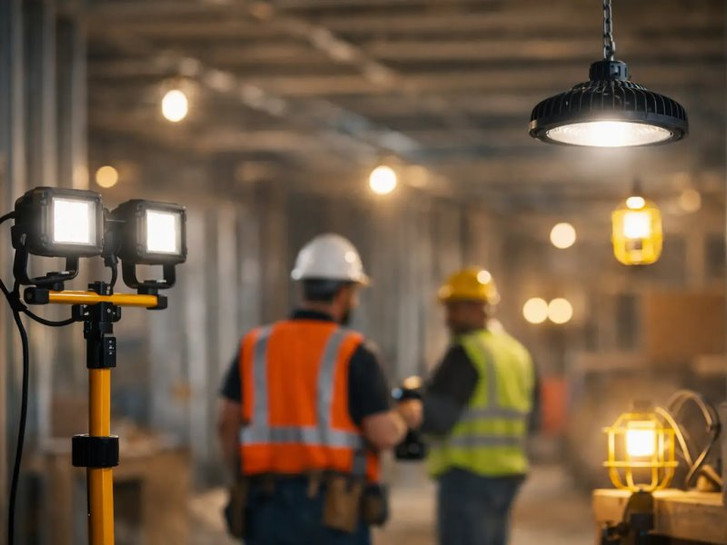
A parking lot with dark corners, a warehouse aisle with uneven light, and an exit path that disappears during a power failure are not minor maintenance issues. They affect safety, productivity, liability, and the operating budget. The right **commercial lighting** plan starts by identifying what people need to see, where they need to see it, and what conditions the fixture must survive.
For contractors, property managers, and facility teams, the goal is rarely to buy the brightest fixture available. It is to specify the correct fixture for the application, install it efficiently, meet applicable requirements, and avoid early replacements. That means looking beyond wattage alone.
## Start Commercial Lighting Selection With the Application
A fixture is only a good value when it fits the site. An LED high bay may deliver excellent output in a distribution center, but it is the wrong answer for a covered entry or a loading dock door. Likewise, a wall pack that works well on a rear service corridor may not provide the distribution needed for a large open parking area.
Begin with the physical environment. Ceiling height, mounting location, existing electrical supply, ambient temperature, exposure to water or dust, and the presence of vehicles or pedestrian traffic all influence the specification. Replacement projects also require a close look at the mounting method and existing junction boxes. A fixture that appears interchangeable on paper can create unnecessary labor if its mounting pattern, conduit access, or voltage requirements do not match the site.
### Indoor applications require usable light, not just high output
Warehouses, manufacturing areas, gymnasiums, and big-box retail spaces often call for [high bays](https://laststoplighting.com/highbays/) or linear high bays. Mounting height and aisle layout matter as much as total lumen output. A wide distribution can help cover open floor areas, while a more focused optic may better suit tall rack aisles.
Offices, schools, healthcare support spaces, and retail interiors typically need controlled brightness with minimal glare. Color temperature should support the task and the environment. Many commercial spaces use 3500K, 4000K, or 5000K LED fixtures, but there is no universal best choice. A 5000K fixture may be practical for an active warehouse, while 3500K or 4000K can be a better fit for customer-facing or office environments.
### Outdoor sites need fixture durability and distribution
Parking lots, drive lanes, building perimeters, walkways, canopies, and loading areas require fixtures built for weather exposure and long operating hours. LED area lights and parking lot fixtures are commonly selected for poles, while [wall packs](https://laststoplighting.com/wall-pack-lights/), flood lights, bollards, and canopy lights address specific zones around a property.
Look closely at the lighting pattern. A fixture with substantial lumen output can still leave gaps if the distribution is wrong for the pole spacing, mounting height, or target area. Exterior lighting should also account for glare spilling onto adjacent properties, driver visibility at entrances, and the need to identify people, obstructions, signage, and elevation changes.
## Calculate Output for the Work Being Done
Wattage tells you how much power a fixture consumes. Lumens tell you how much light it produces. Neither number alone confirms whether the job will be adequately lit.
The more useful question is how much light reaches the work plane or ground surface after mounting height, optics, reflectance, and spacing are considered. For a warehouse, that may mean light on the floor and on vertical rack faces. For a parking lot, it means illumination across driving lanes, parking stalls, sidewalks, and perimeter areas. A loading dock, it includes trailer interiors, dock edges, approach areas, and employee walk paths.
LED retrofit projects often reduce wattage significantly compared with metal halide, high-pressure sodium, or fluorescent systems. That can lower energy use and maintenance demand, but direct wattage replacement is not always reliable. An older 400-watt metal halide fixture does not automatically require one particular LED wattage. Fixture optics, delivered lumens, mounting height, and the condition of the existing lighting system all need consideration.
Selectable wattage fixtures can simplify inventory and provide useful field flexibility. They are especially practical when several areas need similar housings but different output levels. The trade-off is that the selected setting must be documented before turnover, and installers need to confirm the fixture is set correctly, rather than leaving every unit at maximum output.
For larger sites, a photometric layout is worth the effort. It can reveal dark zones, excessive overlap, and pole locations where an optic change is more effective than simply adding wattage. It also gives facility teams a clearer basis for comparing fixtures that may look similar in a catalog but perform differently on site.
## Match the Fixture to Its Mounting and Environment
Commercial fixtures are designed around specific installation conditions. Selecting the correct housing and rating protects the project from premature failures and avoidable service calls.
High bays, for example, may use hook, pendant, or surface mounting. Troffers and panels need the correct ceiling grid, surface frame, or suspension kit. Area lights may require adjustable slip fitters, square pole mounts, round pole adapters, trunnion mounts, or direct arm mounts. Confirm the mounting hardware before ordering, particularly when replacing legacy fixtures on existing poles.
Environmental ratings deserve the same attention. An outdoor fixture may need a suitable wet-location rating, while a washdown area, food-service environment, or dusty industrial space can require more specialized equipment. NSF-rated lighting can be appropriate in food-related applications, and vapor-tight fixtures are commonly used where moisture, dust, or frequent cleaning is expected.
Hazardous locations require a more disciplined approach. [Explosion-proof fixtures](https://laststoplighting.com/explosion-proof-lighting/) are not general-purpose industrial lights. Their listing, class, division, or zone classification, temperature code, mounting method, and electrical configuration must match the site conditions and the requirements of the authority having jurisdiction. When the environment includes combustible dust, flammable vapor, chemical exposure, or process hazards, confirm the classification before selecting a fixture.
## Use Controls Where They Produce Real Savings
Controls can reduce operating costs, but only when they align with how the space is used. Occupancy sensors work well in storage rooms, stairwells, restrooms, back-of-house areas, and intermittently used warehouse zones. Photocells are common for exterior fixtures that should operate from dusk to dawn. Timers and networked controls can help manage schedules across larger properties.
Do not add sensors automatically. In a continuously active loading area or a public path where lighting must remain consistent, an aggressive vacancy setting can become a safety and operations problem. Consider sensor coverage, delay settings, hold levels, commissioning access, and whether the control will remain understandable for the maintenance team after installation.
Emergency battery backup is another function that should be selected deliberately. It can be built into certain fixtures or supplied through dedicated emergency lighting equipment, depending on the application and design. The required runtime, testing process, fixture placement, and local code requirements should be addressed before the order is placed, not after the rough-in is complete.
## Treat Exit and Emergency Lighting as Life-Safety Equipment
Exit signs and emergency fixtures are not finish items to choose at the end of a project. They support safe egress when normal power fails, and their requirements can vary by jurisdiction and building type.
Verify face direction, mounting orientation, chevron needs, battery backup requirements, voltage, wet location suitability, and any local approval requirements. Buildings in Chicago and New York may require specifically approved exit signage and emergency products. A standard LED exit sign may be appropriate in many locations, but it should not be substituted where a local requirement calls for a different construction or listing.
Plan access for testing and maintenance. A fixture that technically meets the specification but cannot be safely tested, serviced, or replaced without disrupting operations creates a long-term facility issue.
## Purchase for Installed Value, Not Fixture Price Alone
The lowest unit price can become the highest project cost if the fixture arrives without the correct mount, fails early in a demanding environment, creates a difficult installation, or does not meet the required application. Compare voltage range, lumen package, CCT, distribution, controls, ratings, warranty terms, dimensions, and included accessories before finalizing a purchase.
For multi-fixture projects, standardizing on compatible products can make future maintenance easier. Keep a record of SKU numbers, selected wattage and CCT settings, driver information, mounting components, and control settings. That record is often more valuable to the next maintenance manager than a stack of old invoices.
Last Stop Lighting helps commercial buyers source routine LED upgrades alongside specialized safety, outdoor, industrial, and hazardous-location products without splitting a project across multiple suppliers. When a specification has open questions, resolve them before installation day. The right fixture should make the site safer, easier to maintain, and less expensive to operate for years after the crew leaves.